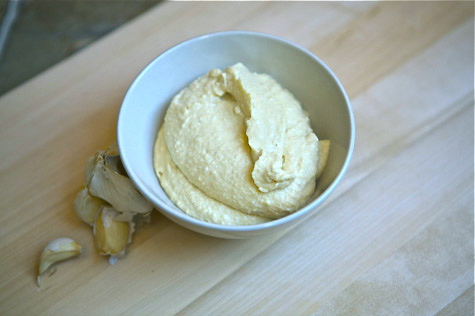
Recently, I wrote a review of that versatile, that visionary, that ever-variable chameleon they call hummus. In response, a number of readers requested my recipe. I’d considered it prior, but to be honest, it just didn’t seem fair. You see, the elegance of hummus is in its simplicity. Posting a ‘recipe’ would feel like cheating on substance. It’s too easy!
But clearly, a recipe is necessary. It’s foundational; the keystone to an entire cache of vegan culinary creations. You must master the primary construction of hummus.
So I devised a scheme, to give you guys the fundamentals you’ll need – the most basic bare-bones hummus how-to – without compromising my quality of content.
I’ve spent the past week entirely immersed in hummus. I slow-cooked an entire pound of chickpeas, and over the course of the week I’ve pounded them, blended them, seasoned them, roasted them, styled them, and photographed them in every iteration or adaptation my little mind could imagine. We’ve eaten hummus every day, sometimes more than once, slathered on veggies, stuffed into pita, clinging to falafel, squished between tortillas, riding on corn chips, rolled up in wheat wraps, and even as dressing on salad. It’s been a tough trail to blaze, but somebody had to do it!
And so here it is, a not-even-close-to-comprehensive guide to what can be done to this spectacular schmear.
We’ll start at the very beginning, a very good place to start.
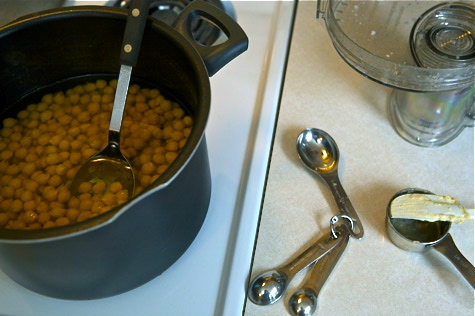
Ingredients:
1 cup chickpeas (aka garbanzo beans), canned or home cooked, drained and rinsed
2 heaping tablespoons tahini
2 tablespoons fresh squeezed lemon juice
1/4 cup ‘liquid’ (half water / half olive oil if you’re concerned with fat, or all olive oil if you’re concerned with flavor, or any ratio in between)
2 cloves garlic
seasoning of choice, added to taste
Instructions:
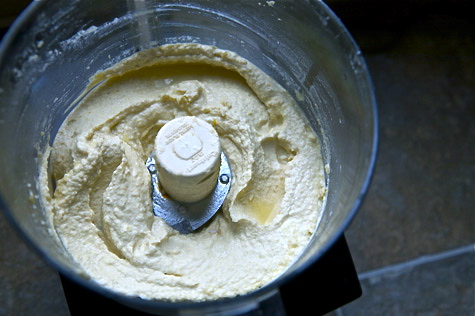
Place all ingredients, except spices, in the bowl of a food processor. If you don’t have a food processor you can use a blender, or an immersion blender, or a potato masher, or a mortar and pestle (old school style!), or whatever you have around. You get the idea.
Blend, blend, blend until smooth and creamy. You may have to add water (or oil) to thin it out. Mix it good and long to get it nice and creamy, and then add your spices to taste. Seasonings may include salt, cumin, garam masala, garlic or onion powder, paprika or cayenne, oregano, basil, dill, thyme, or anything else you fancy. It’ll take a few batches of playing around, but you’ll figure out your favorite ratio pretty quickly. Give it a final blend, and you’re ready to go!
From there, you can do almost anything. I’m not going to offer specific recipes, but here’s just a few of my favorites themes from my extensive experimentation.
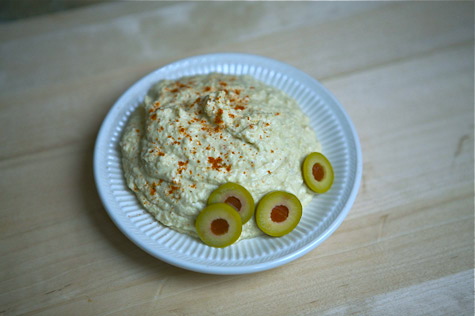 Chunky Olive Hummus, garnished with cayenne and slivered greens.
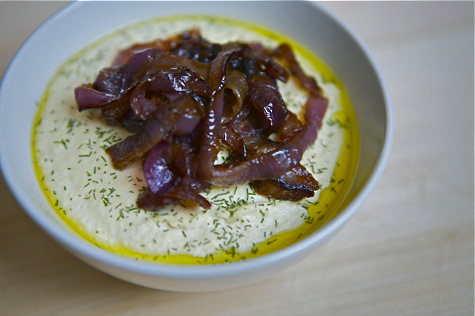 Hummus topped with Caramelized Red Onion and Dill, drizzled with olive oil.
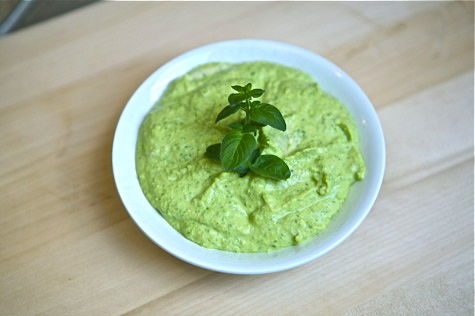 Green Garden Hummus with spinach and freshly snipped herbs. I grow parsley, oregano, and thyme. Topped with a sprig of oregano.
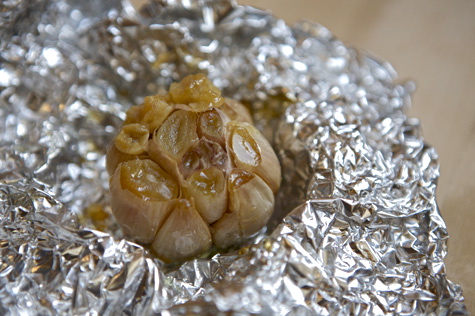
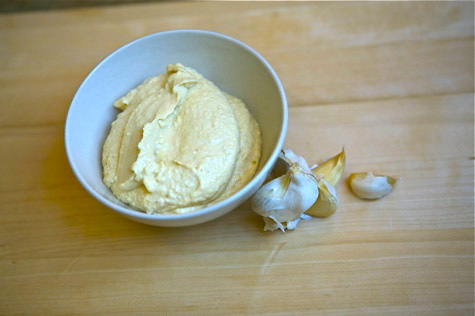 Super Über Garlicky Goodness, with an entire roasted head. This one hurt! Whew!
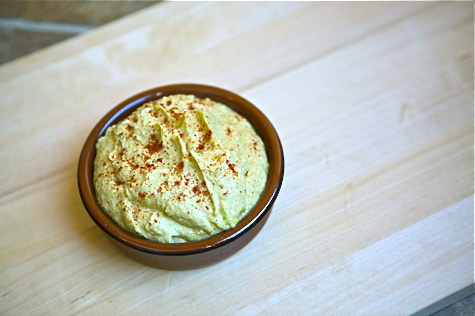 Spicy Avocado Chipotle Hummus, dusted with chili and drizzled with lemon.
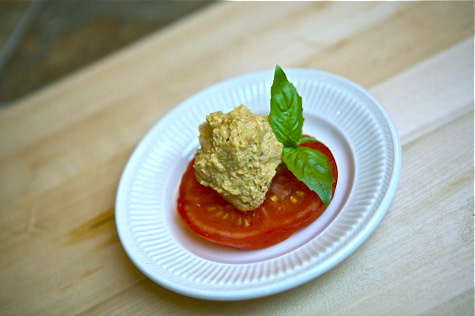 Sun-dried Tomato and Basil Hummus, served on a thick fresh slice.
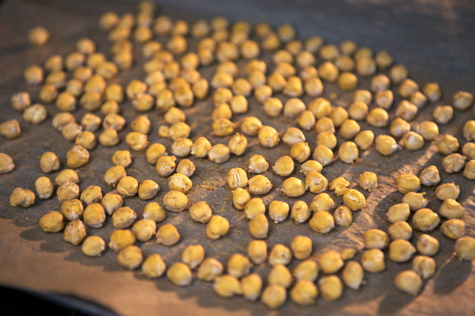
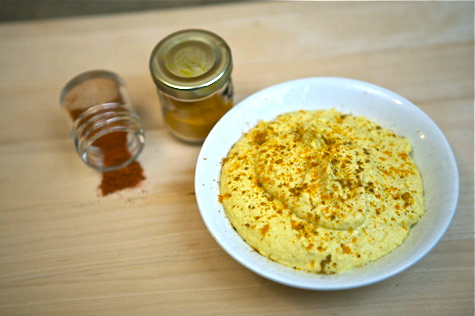 Oven Roasted Chickpea Hummus. This one is great if you want to leave out the olive oil altogether, because the roasting adds a great full-bodied flavor. Cooked in cumin and curry spice, and dusted with cayenne, cumin, and turmeric.
I certainly hope I’ve left you inspired. Clearly, your options are endless, and the flavor combinations are infinite. I’m sure you’ll have as much fun as I did, trying to taste them all! And don’t forget to share your favorite creations!

 Phyllo-wrapped asparagus with pan-seared polenta bruschetta and a simple salad.
Ever since my suger-free birthday, I’ve had half a package of phyllo dough just chillin’ in the freezer (nyuk nyuk), waiting on inspiration.
enter stage left: asparagus everywhere
But of course! What better way to feature this flaky pastry, than to encrust a delicate and delicious asparagus spear? Add a little toasty seed, a little tangy citrus, and you’ve got a sterling seasonal side dish. Just remember to hurry, because asparagus comes in fast and furious, and it’ll be gone before you know it. So what are you waiting for? Get thee to a farmers market, stat!
Ingredients:
bundle of asparagus – about 20 stems
1/2 package of phyllo dough (Athens brand is vegan, as are most others)
3 tablespoons sesame seeds
1 tablespoon sesame oil + more for finishing
1 tablespoon lemon juice
1 teaspoon maple syrup
zest from 1 lemon
Instructions:
Firstly, you’ll need to thaw your phyllo dough, which may take a few hours. After it’s thawed, let it rest on the kitchen countertop under a damp towel, to prevent it from drying out.
Now, put on an awesomely fun vegan cooking podcast to keep you company.
Begin by toasting your sesame seeds. In a small dry pan, roast the sesame seeds over medium heat, just until they begin to brown. Transfer to a small dish and set aside.
In a small bowl, combine the sesame oil, lemon juice, maple syrup, and half of the lemon zest, finely chopping it before you add it in. Whisk to mix well.
Now, peel off the top sheet of phyllo and slice it into four equal, long rectangular pieces. Don’t forget to re-cover the phyllo stack so it doesn’t dry out! Brush each piece of phyllo with enough of the mixture to thoroughly coat, and then sprinkle with sesame seeds.
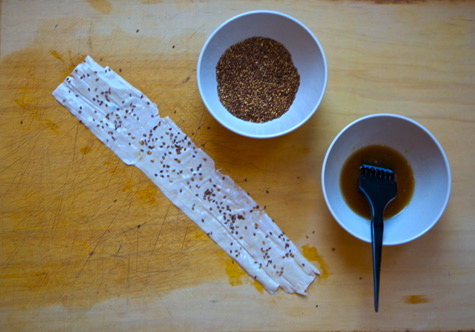
Place an asparagus stalk at one end of the phyllo strip, and begin rolling it up. Angle at a slight diagonal and roll as tightly as possible. These will get prettier as you adjust to the technique.
Repeat until all your asparagus is nicely swaddled in sesame lemon phyllo. Place all the rolls on a plate or two, and refrigerate for about an hour. Keep them covered with a damp towel or saran wrap.
Preheat oven to 425º.
Remove the rolls from the fridge and transfer them to a parchment-lined baking sheet. Sprinkle with some more sesame seeds and half of the remaining lemon zest, and drizzle with any remaining oil/lemon juice mixture (there may not be any left, which is fine).
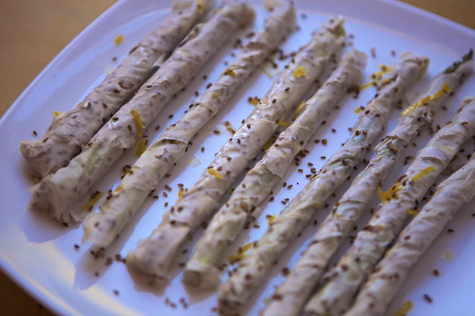
Bake for 20 minutes or so, until the phyllo darkens and flakes.
Finish these off on the plate with a drizzle of sesame oil, and then garnish with the last of the lemon zest. I served them with a sesame soy dipping sauce made from [1 tablespoon sesame oil + 1 tablespoon soy sauce + some finely diced ginger + a sprinkle of sesame seeds]. It was very good.
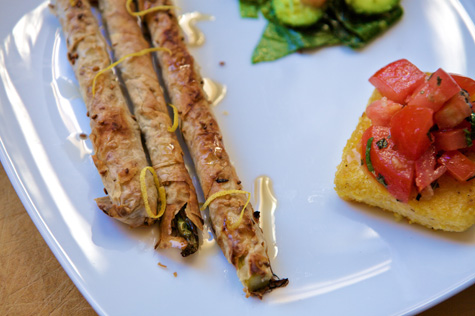
Bon Appetit!
On the first Monday of every month, we take on a ‘mission’ – a shift, a habit, a source of inspiration – to work on together. There’s strength (and support) in numbers! On the last Thursday of the month, we reconvene to see how far we’ve come.
#3
Already our third mission!? Time, she flies . . .
Just as with our first mission, I’m a bit ashamed to admit that I don’t yet do this. But, that’s what the Triple M is for, right? So this time around it’s a return to simple and sustainable, with line-dried laundry.
As I’ve written about in the past, I air dry a lot of the laundry, draped over chairs and shoji screens and strewn about our office. But it’s time to make a total commitment. It’s time to string up a clothesline, find some wooden clothespins, and track down an indoor drying rack – all secondhand of course! June is perfect to start this project, ’cause the weather does all the work for you! I aim to be 100% dryer-free in 1 month’s time. And I’ll expect you all to hold me to it!
Do you line dry your laundry? If you do, let us in on your method and any tips you’ve picked up.
If you’re not line drying yet, do you choose to accept this Mission?
BONZAI!
Itty Bitty Bonzai is a collection of tiny tips and tricks for living a life more mindful. Small actions, collectively and compounded, become a powerful force of change.
#7 How green is your hygiene regime? Specifically, what’s washing those pretty veg*n chompers? No, I don’t mean the homemade baking soda scrub (although we’ll be covering that soon!) – I mean the toothbrush itself.
Uh-oh, it’s probably plastic, right? Well lucky for conscientious consumers, there’s a few progressive products out there to take your pearly whites to a whole new shade of green!
I use Preserve, available online as well as nationwide at Trader Joe’s. Each brush comes with a small postmarked pouch, so that when it’s worn out you can mail it back to the company. They recycle old brushes into brand new tools. So cool!
But you want a mechanical model? Radius has you covered. Their Intelligent electric toothbrush has a replaceable head, and they’ll even help you dispose of the batteries.
And don’t forget, those old brushes make great additions to your DIY cleaning kit!
BONZAI!
My Dearests! Here it is, we’ve reached the 100th post on Bonzai Aphrodite!
Just shy of 4 months into this project, I want to take this opportunity to express my extreme gratitude for all of you. For the overwhelming support I’ve received, for the endless enthusiasm you’ve all shown, and mostly for the inspiration you guys give me every day. You are an incredible group of people! THANK YOU!!!
So let’s all raise glasses and toast, to many hundreds more! Sending lots of love and *chicken kisses* from HQ!

Oi there! Hello hello! I’m so glad it’s the weekend, aren’t you? And of course that means it’s time for your feedback. So don’t be shy – get involved! This website is here for you, and building your community – so jump right in and share your comments, critiques, thoughts, support, and suggestions.
What’s been tickling your noodle? What are you scheming and dreaming up? Which section of the site applies? (the food? the fashion? the farm?) Which articles have interested you recently? What do YOU want?
As always, the Feedback Forum will be hanging out here at the top of the page all weekend. So you can check back any time and drop a line. We’d love to here from you! Have the most magical weekend!!!

Up high on Damian’s list of favorite foods, there’s a special spot for curry fried rice. But alas, fried rice is notoriously finicky! So often it ends up sticky, smooshy, or super oily. I’m really good at getting the ‘smooshy’ type. Curry fried rice pudding? Not so much with the nom.
So I came up with this alternative, which offers the same flavors but without the potential disaster. It’s easy to assemble and the texture is lovely – no sticky, no smoosh, and no oil slick! The rice holds up well through baking and doesn’t deteriorate at all, yet the overall dish remains moist. And of course, it’s baked instead of fried, so it’s much better for you. Bonus!
Ingredients
4 cups ‘leftover’ brown rice (cooked and then refrigerated for at least 24 hours)
1/2 a medium eggplant, cubed
white onion, slivered
poblano pepper, sliced
other veggies like bell peppers, tomatoes, green beans, etc
4 cloves garlic, crushed
about an inch of fresh ginger, finely diced
1/2 a pineapple, cubed (if you don’t have fresh, use 1 can pineapple chunks)
2 cups vegetable stock
2 tablespoons red curry paste (my favorite)
2 tablespoons soy sauce
1 tablespoon agave
optional: 1/2 cup raw cashews
Instructions
Preheat oven to 350º.
Oil a large pan over medium-high heat, and add the garlic and ginger. Sauté until browned. Add the eggplant, onion, and poblano, and sauté until onion gets glassy. Add the remaining veggies and cook for a few minutes, then remove from heat.
Put the rice in a giant mixing bowl and dump everything else on top.
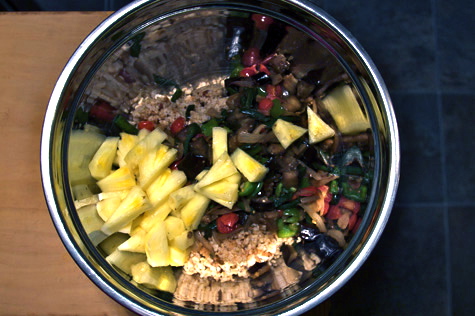
Stir it around so it mixes together real good. *Slop slop* This is the fun part!
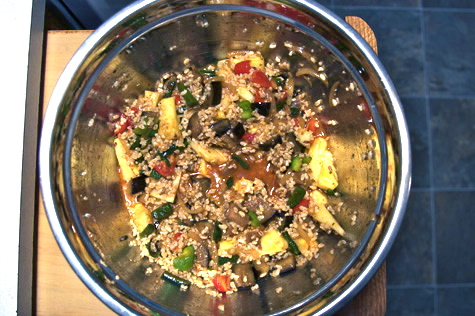
Dump the mix into a large, lightly oiled casserole dish, and spread it out evenly. Cover with foil and bake for 40 minutes, then uncover and bake another 15-20, until the liquid is just gone.
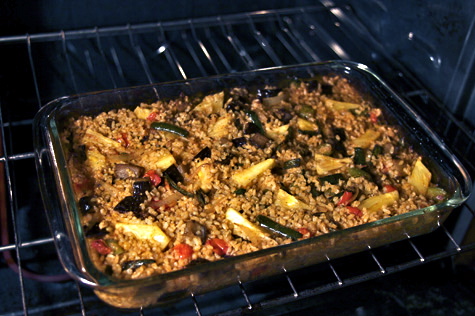
Stir to ‘fluff’ before serving. Drizzle with hot chili oil and soy sauce to taste. NOM!
I’ve spent the past few days sort of passively reflecting on this experience, gathering the insights I’ve gained and preparing to set my intentions as I re-enter the world of variable consumption. I remember coming off of my last cleanse and feeling like I had really been through an Odyssey. Like Homer’s hero, I had battled my modern mind’s equivalent of the Cyclops and the Sirens. I swear to you, my ten days felt just like the ten years Odysseus traveled.
But this time . . . not so much. So now, the question becomes not ‘What will I do with all this newfound knowledge?’, but instead ‘Why didn’t I have an earth-shaking voyage?’ Here are my three theories:
Animal Poison – I wasn’t a veg*n the last time I did this, and I was carrying a load (a lifetime!) of contamination. Really, I could spend the rest of the night writing about the toxins hidden in meat and dairy, both the ‘man-made’ (antibiotics, etc) and the ‘natural’ (cholesterol, etc), and the myriad health risks that come with consuming them. I suppose that now is not the place. Suffice to say: 1) read The China Study, and 2) I suspect I simply had less to let go of.
Chemical Poison – For a long time I ate organic ‘when I could afford it’ . . . which wasn’t very often. After my last cleanse I tried to eat as organic as possible, without worry towards the cost. Over the course of the year I’ve evolved my habits and loosened my [perceived] purse strings (it’s really, really not much more expensive), and incorporated more organic standards. Then during my raw month, and ever since, I’ve eaten almost exclusively organic. And now a year later, I think I just have less chemicals to expel. Organic matters!
Emotional Poison – Cleansing is more than just a physical healing; it’s also a deeply personal experience. Your body is discharging its built-up waste, while simultaneously, your mind is surrendering its pent-up negativity. Cleansing repairs the whole package. And last time I cleansed, I was immersed in one of my toughest times. A quarter-life crisis, if you will. Since then I’ve put in a lot of work, a lot of intentional growth. And though I’m nowhere near the end, my direction is much more clear. Perhaps regaining my strength and stability made for a more mellow journey.
Do I sound like I’m saying this was easy breezy? Because I certainly don’t mean to imply that it was. I’ve had my rough spots for sure, my splitting headaches and fuzzy teeth and tearful outbursts. But compared to the last go-around? Well there’s just no comparison, really. Still, it’s a valuable experience. There’s always something to learn.
Last time my body had been through hell and was screaming out for change. So I set six ambitious intentions for myself: 1) Drastically cut down salt. 2) Eat organic as often as possible. 3) Eat less meat (ha!) 4) Eat less dairy (!) 5) Sugar for special occasions only. 6) Reduce coffee and alcohol intake.
And this time around, instead of screaming, I feel like my body is singing. Singing ‘thank you’ for those life choices I made. The past year has brought so much positive change, and what I have learned from this cleanse is that I’m on the right path.
So my new intention is simply this:
Keep on being good to myself. It’s working.
Lot’s of love to everyone out there, especially my fellow cleansers. We did it!
Today was very much like yesterday – almost identical in fact. I felt great all day, a little cranky in the afternoon, and worked worked worked late into the night. I just can’t believe that tomorrow is my last day!
I feel like I could continue this cleanse indefinitely. I really don’t feel hungry, and my energy is good enough – not great, but okay. I didn’t get it last time, but now I feel like I understand how people can fast for forty days. I see that it’s possible.
But me? No way! I miss food too much. I find myself extremely jealous when my husband eats dinner (partial cause of the cranky, I’ll bet), and I’m excited at the prospect of produce season and farmers markets coming up. Mostly, I believe that the main reason this cleanse has been so easy for me this time around, is simply that I don’t need it as much. So why continue with something unnecessary? More on that in tomorrow night’s final wrap-up . . .
Bed time! I’ve been sleeping like a baby these days, and loving every snuggly minute of it!
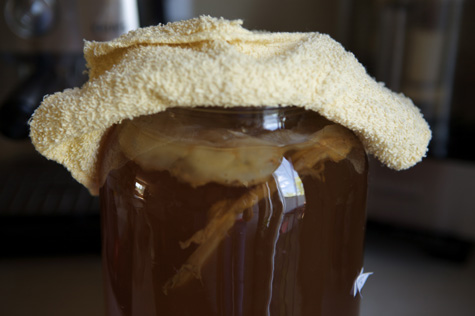
Kombucha, that magical mysterious elixir, is actually quite easy to produce with a bit of kitchen chemistry. I wrote about Kombucha a few weeks back, after I’d finished my first batch. And as promised in that article, here’s your step-by-step guide to home brewing.
What You’ll Need:
- A living SCOBY + some starter tea
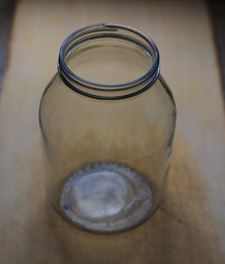
- A large *glass* jar (no metal, no ceramic, no plastic, etc) with a wide opening (a standard 1-gallon jar, as shown at right, is best)
- Sugar
- Caffeinated tea
- A very clean cloth + a rubber band
- A steel pot and a big metal stir spoon
Prep Work
- Most likely, the hardest part will be getting your hands on a SCOBY. You’ll just have to be creative and snoop around your city for a source. I suggest starting with Craigslist or googling ‘[your city] kombucha’. You can also try poking around your local co-op or health food store – and check the bulletin board.
- Once you’ve secured a SCOBY (and it’s alive, floating in some starter tea), you’re on your way. Make sure your workspace is clean and at least semi-sterile. Gather and clean your tools (see above).
- This is a long process, so set your schedule accordingly. Brewing is a good Sunday project; you can have it going while you’re gardening or cleaning or laying around naked with your sweetheart.
How To Brew
1) In a large, stainless steel (non-teflon or other weird material) stock pot, boil 1 gallon of water. Keep it at a full boil for at least 10 minutes.
2) Remove the pot from heat and add 1 1/4 cups sugar, stirring with a metal (non-plastic, non-wood) spoon. I use organic evaporated cane juice instead of white sugar. DO NOT substitute agave, honey, Splenda™, or any other sweetener.
3) Add the tea. Any kind, as long as it’s caffeinated. This will determine the final flavor, so if you use a cranberry green tea, you’ll get a cranberry-ish flavored kombucha. I usually use organic plain green or black tea bags. You can use bagged or loose tea, but if you use looseleaf make sure it’s in a fine-meshed infuser. You don’t want any tea leaves floating about!
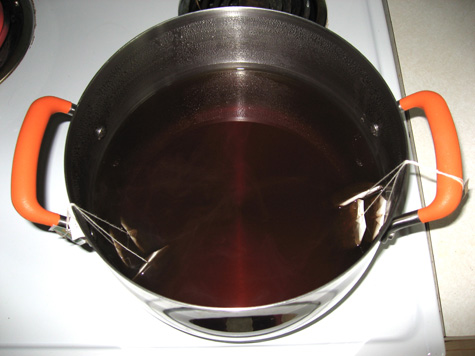
4) Steep the tea for about 4 hours, allowing the water to cool and the tea to get nice and strong. Go ahead and garden or clean or or lay around naked. When the tea is good and strong (many hours later), take out the tea bags/infuser.
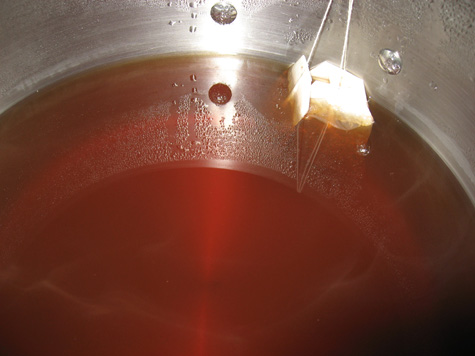
5) Double check that your widemouth glass jar is very clean, and then pour in the gallon of sweetened tea. A funnel can really help with this.
DON’T USE ANY METAL BEYOND THIS POINT
Metal reacts poorly with the kombucha culture. It’s not a good thing.
6) Wash your hands thoroughly before handling the SCOBY.
7) Open your SCOBY + starter container, and pour the starter into the widemouth jar. There may be gooey strings or giblets – that’s just SCOBY stuff, and it’s fine.
 Fish out your SCOBY. Admire it’s alien oddity. Blow it a kiss. Give it a name (mine is Scoby-Doo). Notice that there’s a ‘smooth side’ that is lighter, and the other side is darker. The slimy dark stuff is yeast. You’ll also notice that familiar, uniquely komucha-esque odor!
9) Now carefully slide your SCOBY into the widemouth jar, smooth-side up. It may sink, which is okay, but it will probably float.
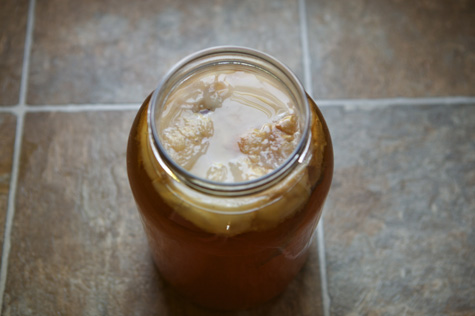
10) Place the clean cloth over the top of the jar, pulling it taught and securing with a rubber band. Now you just need to tuck that sucker away for 2-3 weeks. It prefers a warm dark spot, like in a cupboard or closet. It does not like drafts or sunlight, so don’t brew your kombucha on a window sill!
11) Adjust the brew time for your taste preference. The warmer it is, the faster it will brew. The more caffeinated it is, the faster it will brew. The longer you let it brew, the stronger and less sweet it will be. I like less sugar, so I ferment for at least 3 weeks. It’s not recommended that you brew a batch longer than a month.
— weeks later —
12) First, you’ll need to remove the SCOBY. Every time you brew, the ‘mother’ (the original SCOBY) grows a ‘baby’ (a new SCOBY). These names are misleading because the two are identical in every way, indistinguishable from one another. They’ll be stacked together, like two pancakes. You can either leave them be and keep on going with a double-thick SCOBY, or you can carefully separate them. If you do take them apart, each one can brew its own batch. Then you can stagger your batches for constant kombucha flow! Remember: each time you brew, the mother makes a baby.
13) You’ll need a jar to hold your SCOBY while you’re not brewing. Make sure the jar has a plastic (non-metal) lid. With very clean hands, fish your SCOBY out of the widemouth jar and fold it into the storage jar. Then add enough of the new brew to completely cover it. This is your starter tea for next time. Store the SCOBY + starter tea in the refrigerator, indefinitely.
14) Portion out your brewed kombucha into smaller storage containers. I save glass bottles with plastic lids just for this purpose. Store the tea in the fridge for up to 6 weeks.
15) Drink! Experiment! Enjoy!

Notes on Safety
- Wash your hands, wash your hands, wash your hands.
- Sometimes a culture will become contaminated. It happens! If your SCOBY shows anything resembling mold, TOSS IT! If your brewed kombucha comes out smelling funny, TOSS IT! If your kombucha ends up tasting funny, TOSS IT! Remember, there’s only a porous rag separating your fermenting sugar water from any and all airborne bugs. Contamination can happen, so be wise and play it ‘better safe than sorry’, okay?
- If you want to add fruit juice to your kombucha, do it after you’ve brewed. DO NOT add fruit juice before fermentation.
- Don’t use bleach on any of your kombucha-making equipment. Vinegar is a great cleanser. The dishwasher (with a mild detergent) is also okay.
- Listen to your body! Start by drinking a little at a time. Home brew is A LOT stronger than the store bought stuff, and the B-vitamins can get you quite heady. So take it slow and listen to your body!
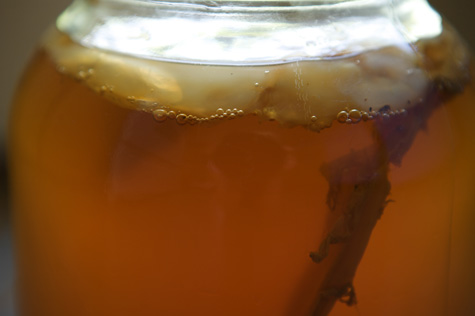
Close-up during the brewing process - you can see it bubbling away!
***DISCLAIMER – My dears, I cannot be held responsible for what you do with this information. So please, use your big beautiful brains, and be thoughtful and be careful.***
I know there’s been a ton of interest out there, so I can’t wait to hear how this works for you guys. Make sure to report back! And LUCK!