The American Dietetics Association is the worlds largest independent, non-partisan authority on nutrition and health. In the latest edition of their journal, the organization released an updated position paper which explicitly addresses vegetarian diets (Journal of the American Dietetics Association, July 2009). The paper clearly articulates:
“It is the position of the American Dietetic Association that appropriately planned vegetarian diets, including total vegetarian or vegan diets, are healthful, nutritionally adequate and may provide health benefits in the prevention and treatment of certain diseases. Well-planned vegetarian diets are appropriate for individuals during all stages of the life-cycle including pregnancy, lactation, infancy, childhood and adolescence and for athletes.”
They continue endorsing the lifestyle, stating that vegetarian diets may aid in the prevention and treatment of chronic diseases, such as cancer, diabetes, and obesity. This outlines the official opinion of the American Dietetics Association.
I would just like to take a minute and say, “Woo-hoo for progress! Baby steps, baby!”
Bonzai!

On the first Monday of every month, we take on a ‘mission’ – a shift or habit or inspiration – to work on together. There’s strength (and support) in numbers! On the last Thursday of the month, we reconvene to see how far we’ve come.
#4
Sorry mens, but this one’s for my girlies. Not that you can’t play too! Every guy has women in his life, be it a mother, sister, partner, daughter, or friend. Why not politely pass this info along?
Let’s start with some troubling statistics. An average female uses (and throws away) 12,000 tampons or pads throughout her lifetime. That’s over 250 pounds worth of biohazard waste. Over 12 billion tampons are making their way into North American landfills each year. Or, you know, not making their way. For example, over 170,000 tampon applicators were collected on American beaches from 1998-99.
And that’s just the waste! I won’t even get into the carcinogens contained in tampons or the noxious production of the polyethylene plastics used in pads.
Ladies, it’s time to take action! We have choices here, real options that aren’t harmful to us or our environment. There’s quite a variety of cotton/cloth washable pads, as well as safe reusable ‘menstrual cups’. For more info on a wide selection of products, check out the Lunapads website, or find cloth pads on Etsy, or give the DivaCup a shot. Or, why not try making your own cloth pads?
If you’ve already traded your disposables for an alternative, what do you use and how does it work for you?
To my other fellow females, do you choose to accept this Mission?
BONZAI!
Oi there! Hello! It’s Friday, and so once again it’s time for comments, critiques, thoughts, support, and suggestions.
Firstly, I want to say ‘Welcome!’ to all our new readers. I’m so happy to have new eyes and ideas, so please don’t be shy and make your voices heard! Which section of the site is your favorite? What would you like to see expanded? (the food? the fashion? the farm?) What do YOU want to see here?
Every weekend the Feedback Forum hangs out here at the top of the page, so you can check back in and have your say. If you’ve got an idea or a question or you just want to introduce yourself and say ‘Oi!’, this is the place to do it!
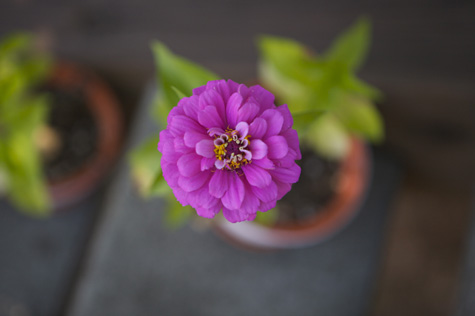
And since I promised, remember my little zinnia seeds, the first I planted this year? Well, they’re finally blooming!
On the first Monday of every month, we take on a ‘mission’ – a shift or habit or inspiration – to work on together. There’s strength (and support) in numbers! On the last Thursday of the month, we reconvene to see how far we’ve come.
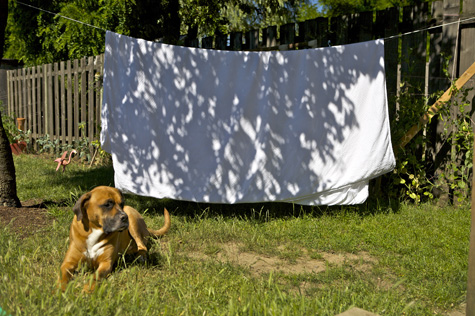 Harley guards the yard from vicious ladybugs. He is fearsome, can you tell?
For this month’s mission we sought to save energy by air-drying our laundry. And by ‘we’, I pretty much mean ‘me’, because you all promptly informed me that you’re way ahead of me here. Haha, whoops! But you guys had great suggestions and I’ve had fun customizing my method. We’ve also gained a lot of readers this month (hi guys!), so maybe they’ll benefit from the project. Here’s what I decided on:
Firstly, the outside line. I got a simple retractable 15 footer, gently used, on Craigslist. It even came with wooden clothes pins! Strung between a deck post and the plum tree, it’s perfect for our long skinny yard. The dogs are getting used to it.
But of course, this is Portland and we have weather here. If I’m really going to nix the dryer, I’ll need an indoor option. I thought about getting a couple of wooden racks, but man! – those take up a lot of precious floor space. A little scheming, a little dreaming, and Damian and I hit upon the perfect solution. Hanging racks!
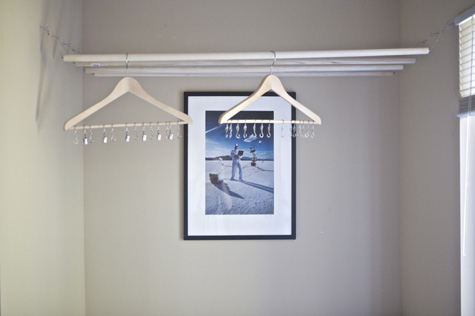 In the ‘nook’ next to the washing machine, suspended above the big dog bed.
This was super simple, and really really cheap. We just used 4 rods, attached to the wall with eyehooks and wire. We kept them neutral in appearance, although admittedly, aesthetic wasn’t the driving force here. I think you could actually make them look really neat – like découpage-ing colorful magazine cutouts all over them. Who knows? Get creative, have fun with it!
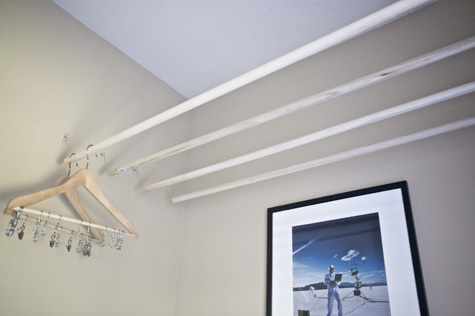
 This is my favorite part! I rigged two hangers with some leftover curtain clips I had laying around. Works great for socks and skivvies!
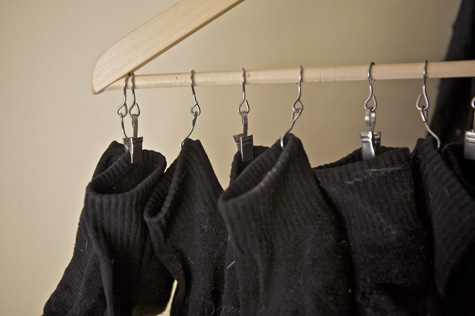 So cute!
What about you guys? What are your creative drying solutions for this monthly mission?
Itty Bitty Bonzai is a collection of tiny tips and tricks for living a life more mindful. Small actions, collectively and compounded, become a powerful force of change.
#8 So, we’ve all agreed that wasting paper is bad. We’ve canceled our newspaper subscription and we recycle all our mail and our ‘brown bag’ lunch comes in a canister. But unfortunately, 90% of our households are still reliant on one of the worst wasters of this limited resource: napkins.
It’s time to end it, guys! Paper towels and their ilk account for 3,000 tons of landfill waste each year. That’s millions of trees – trashed. Is it really worth the perceived convenience?
Instead of traditional paper products, try using dishrags around the kitchen. Rip up old towels for dirty cleaning jobs. Dine in style with cotton napkins. Stash a hankie in your satchel (or your back pocket, for fashion and for function!) so you won’t ever get caught unawares. Add a small cloth to your packed lunches (or your kids’), and keep a supply in the glovebox, too. It’s so easy to cut out unnecessary paper, and once it’s habitual, you’ll wonder why it took you so long.
And just in case you’re wondering, it takes less than half the energy of paper production, to fabricate and then re-clean a cloth towel over its lifetime.
BONZAI!
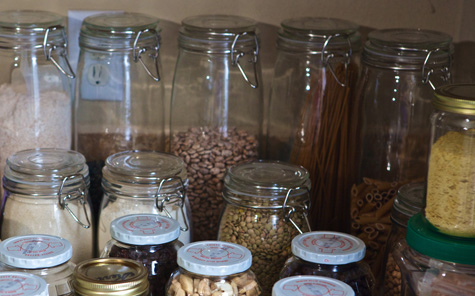
After writing about my grocery shopping process, I wanted to include a little visual addendum. A lot of people are unfamiliar with buying in bulk, and it can be intimidating if you’re unsure of the process. So to demystify it, here’s how it looks:
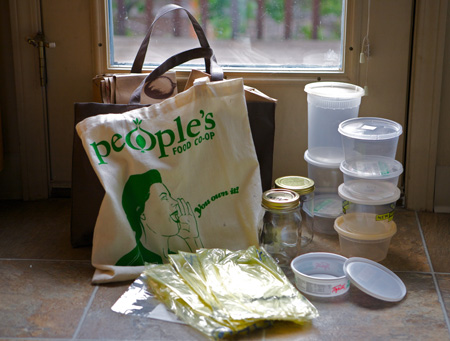
These are the supplies I bring on one of my marathon grocery shopping excursions.
- Multiple canvas or re-used paper grocery bags, for bringing home the booty.
- Re-used plastic food tubs, best for bulk liquids like oils and syrups.
- Many many re-used plastic produce baggies, for dried goods like rice, beans, and baking flours. Also, you know, for produce.
- Stickers and pens for careful labeling, and notepaper for calculations
- Glass jars, because there’s never enough containers . . .
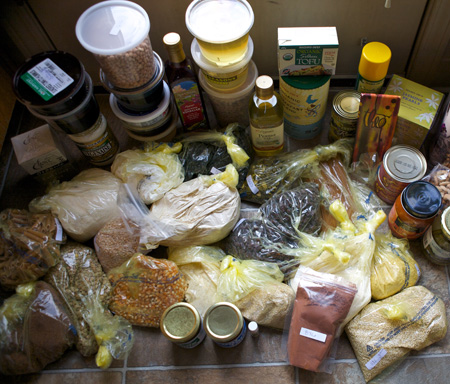
And this is what it looks like when I get it all home – you can see why labeling is so important! Now, I could just stop there, throw the dried goods in the cupboard and the perishables in the fridge, and call it a day. But of course, I’m much too meticulous for that sort of haphazard attitude!
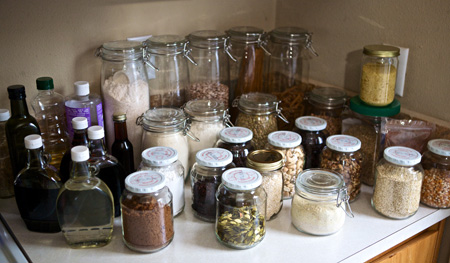
In my kitchen, everything has a home. I use retro glass canisters to store my flours, beans, and pastas, displayed on my kitchen counter (back and second row). The rest are stashed away out of sight. I use old apple sauce jars (they’re perfect!) for all my fruits, seeds, and nuts; of course they have to match because I’m crazy like that, and it also helps them to stack easily. The rest are random jars for random stuff, like the bran that lives in the fridge and the Nooch that hangs on the seasoning shelf. I saved a bunch of syrup bottles from my last Master Cleanse (far left) and they’re great for holding tamari, agave, molasses, etc. Sometimes I keep the original jug and just keep refilling it, like the big brown rice bin (on the right with the green lid) and the olive oil, canola oil, and castile soap bottles (back row left), all of which I now buy in bulk. Organization is key, at least for me.
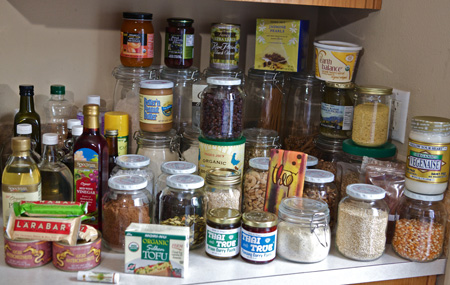
And just for posterity’s sake, this is what my whole haul looked like. That’s about $160 worth of groceries, and quite a few big-ticket items like nuts, fancy oils and vinegar, those amazing local Thai curry pastes that go for $5 a pop, etc. But, working in tandem with my produce method, this will last us quite a few months. All things considered, it’s incredibly thrifty. But most importantly, eating like this – whole foods, real foods, made-from-scratch plant-based meals – is the healthiest thing you can do for yourself. And SO YUM!
Going over my grocery list, a discerning eye might notice the distinct absence of one key group: fresh fruits and veggies. But do you really think I’m skipping my greens? Hells no! Quite the opposite in fact – local produce makes up the majority of my diet!
I alluded to my practice of produce scouting in my last grocery article, and I thought it could use a follow-up now. But let me first say that everybody’s situation is different, and this advice is only meant to inspire, nothing more. Keep in mind that I didn’t create these habits overnight. I have spent years adjusting my lifestyle to suit my aspirations, and as far as I’m concerned I still have a long way to go. We’re all on this journey together and we’re all doing just as much as we can!
So, this is how I keep my crisper flowing with fresh, seasonal goodies – all on a shoestring budget. Remember, these rules ONLY apply to produce, okay? I’m not advocating you browse the snack aisle every day!
1) Buy Organic Okay, this isn’t a trick for shopping, this is a tip for LIFE. If you’re not quite sure what ‘organic’ entails, I summarize the process in my article, Interpreting A Label. Eating organic is essential guys; we implement steps 2-5 so that we are able to buy organic. This is a must!
2) Shop Often I visit my little local market at least every day, sometimes more than once. I’ve worked it into my routine - I swing by the store on my morning dog walk - so it’s never a chore or a hassle. Perhaps there’s a fruit stand en route to your office, a veggie vendor next to your gym, or a co-op just past your coffee shop. However you can work it into your day, you should find a quality produce mart and make your visits habitual.
At my shop, there’s a special shelf outside. Throughout the day they collect the fruits that are losing their luster, the veggies beginning to wilt, or anything that’s overstocked. They bag up the second-rate pieces, and periodically place them on the shelf – at just $1 per bag. That’s why it pays to keep checking back!
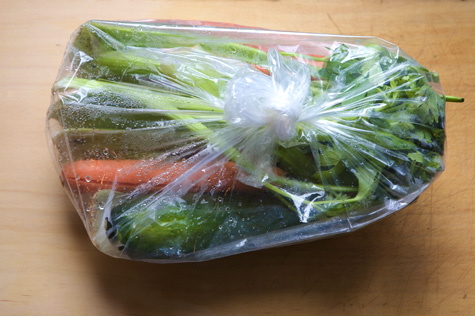
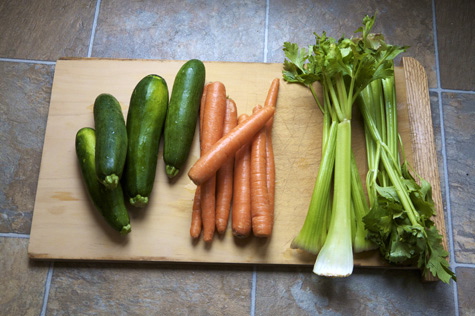 Contents of a recent dollar bag.
So okay, not every store does ‘dollar bags’, but most are willing to drop their prices on less-than-perfect products. Check out all your local markets, find the one with the best bargains, make it your go-to grocer and Check Back Often!
3) Shop Local The kinds of deals described above? You won’t find those at chain supermarkets, like Safeway, Trader Joes, Whole Foods, Kroger, or even (gulp!) Wal*Mart. As a former employee at one of these corporate giants, I’m appalled at how much food is simply wasted! But the overhead is so high and the operation is so large, that they can afford the losses. This isn’t true of the little local guys, and thus they’re willing to take the cut if it means they’ll still make a sale. In other words, ‘SuperMegaMonsterMart’ will toss their beat-up broccoli bunches, but ‘CornerStoreCooperative’ will happily sell you the blemished bundle for a fraction of the price. Score! And this way everyone wins.
4) Shop Sales Even if your market doesn’t offer drastic discounts on aging items, they’re bound to offer sales. When it comes to seasonal produce, prices constantly adjust to accommodate supply. In a local grocery shop, the farmers bring in a haul whenever the crop is ready, all at once – and that means SALE! A few weeks ago I nabbed some perfectly ripe and delicious organic cantaloupes for a dollar apiece, all because of the overflow! That’s not going to happen at big box grocers, and certainly not at that quality of smaller regional farms.
Much like my produce market, my co-op keeps a single shelf especially for sales. That’s where the ‘eyed’ potatoes go, along with the limp lettuce and soft spotted fruits. And that’s where *I* go, too! For a third of the cost, what do I care about a little bruising?! It’s all going into the blender, anyways!
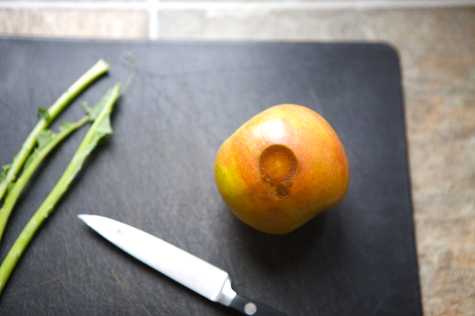 Organic gala apple – ‘Oh no, but it’s sooo ugly’!
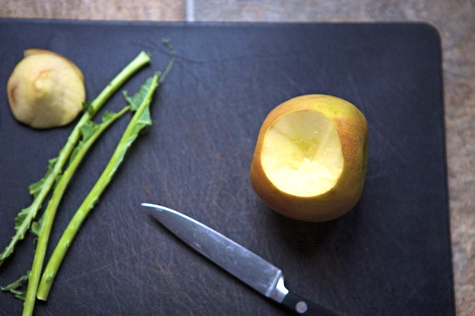 Organic gala apple, ready to get green smoothied . . .
If you stick to shopping sales, you can save hundreds each year. It’s really that efficient. All it takes is a little loosening up, which leads into our final point . . .
5) Shop Open-minded The key to my entire method is maintaining a sense of spontaneity. I simply can’t be tied to a preconception of what I’ll eat, because I never know what I’m going to find. Instead, I try to treat it like a challenge! It keeps me creative in the kitchen, and I like living on my toes like that. So many times I’ve opened a bag to find a veggie I’ve never encountered before. But luckily, “How the hell do I cook this??” is one of my favorite questions! If you can approach your kitchen with that kind of attitude, you’ll save yourself a lot of anxiety – and a whole bunch of money!
I hope these ideas have given you something to think about, and that you can incorporate some of my style into your own routine. The most important thing is that we’re all healthy and happy. By eating good food and keeping good community, we’re off to an excellent to start!
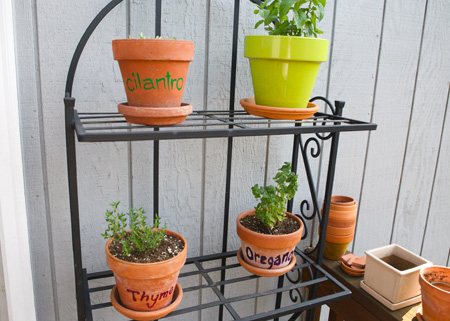 The Essentials: Cilantro // Mint // Thyme // Oregano
Living in a tall, small-footprint townhouse, I’m always aiming to boost my usable ‘acreage’. The front steps and side run host flowers and berries, the backyard is ruled by animals and vegetables, and the second floor deck – directly off the kitchen – is the perfect spot to stage an herb garden.
I raise my fresh herbs in containers each year, mostly to maximize space but also just because I enjoy the technique. Growing food has been in my life for as long as I can remember, from the single parsley plant we had on our student housing windowsill when I was wee, to the tomatoes I tended amidst the craziness of college. What appeals to me most about container gardening, is that anybody can do it. Anywhere, in any sort of residence and on any sort of income.
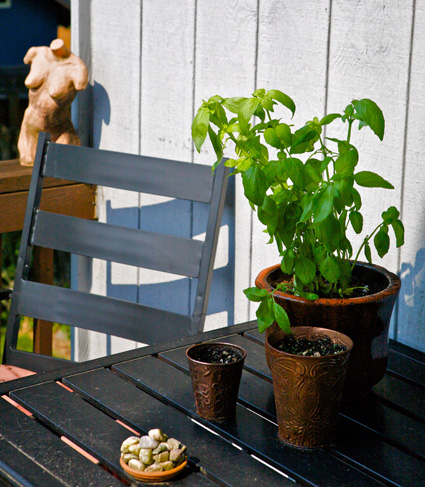 Basil, my other must-have herb. The 2 small copper pots are sprouting red poppies.
My deck is positioned north-westerly (like my garden) – proof that you don’t need southern exposure in order to cultivate crops. And for potted plants, less sun can come in handy. Remember, these guys are a bit more delicate and they’ll dry out rather easily. Less insulated than their in-ground kin, they’ll need to be watered frequently and they’ll be more sensitive to temperature shifts. Luckily, they’re portable!
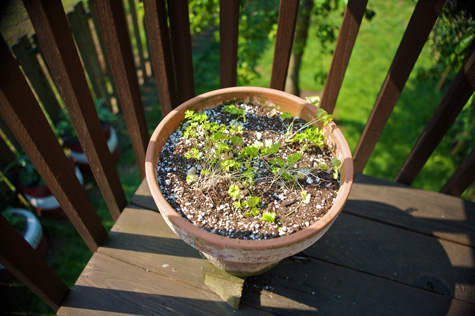 My big pot of parsley, overlooking the garden below (I spy potato tires!)
This simplified form of farming is truly opportune. It’s especially great for the novice grower, unsure of committing to a proper plot of land. Here’s just a sampling of the advantages:
- Firstly, and clearly, it doesn’t require the ground! You can homestead in a high-rise, you can farm in a dorm, I’ve even heard of planting out the flatbed of a pickup. Now that’s a portable garden!
- ‘Mobility grants flexibility’. A movable, manageable garden means you can really cater to the needs of the plants. So, you can grow a wider range of non-native species that wouldn’t make it on their own outside.
- Containers are much less susceptible to predators, pests, weeds, and disease. They’re their own little ecosystem, so easy to protect!
- Finally, they’re just so damn convenient. That’s why they’re favored by chefs and florists alike – growing in pots means easy-peasy access.
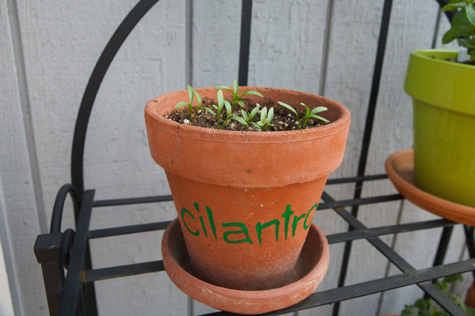 The cilantro springs to life, less than 2 weeks old.
One of my favorite aspects of the technique are the aesthetic options it lends itself to. I haven’t gotten too crazy with my containers, but I’ve seen perrenials planted in boots and shoes, I’ve seen herbs in teapots and flowers in televisions, tomatoes climbing out of bird cages and cabbages crowded into bathtubs. Anything that holds soil can be used as a planter. Have fun and get creative!
I use a supply of terra cotta pots I’ve collected from garage sales and giveaways over the years. I’ve hand painted each one for its herb, and I’ve also considered bedazzling them with rhinestones (if anyone does this I MUST see pictures!) or even découpage-ing them. Craft-tastic!
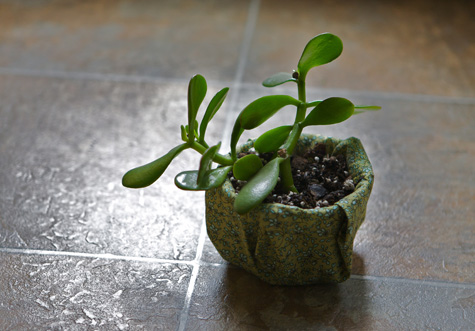
Another [free] option for a makeshift pot is to re-purpose your old plastic food tubs. If you want it to be pretty-like, just paint it! Or, you can get all Martha Stewart on it:
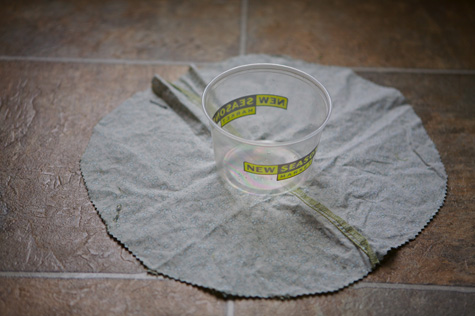
Use an old camisole or pillow case or other pretty piece of fabric and cut it into a big circle. Fill the tub with potting soil, fold the fabric up and tuck it into the soil, and then plant your intended seedling. And voilà, a precious little planter.
I have grand future plans for an expanded indoor orchard, plans that include some exotic and tropical species. Who says you can’t grow citrus in the Pacific Northwest, am I right??
But for now, I’m just happy it’s summer and fresh herbs are aplenty. Many, many mouthwatering recipes to follow!
Man, I spend a lot of time thinking about food. As an enthusiastic veg*n, a sustainable/whole foods advocate, a food systems activist, keeper of my very own food forest and cooker of all things herbivorous . . . I tend to have food on the brain. Um, also, I just really like to EAT!
And as a food blogger, I receive a lot of inquiry. People often ask about where and how I shop, whether it’s organic, tips for eating better and tricks for spending less – those sorts of standard questions. But beyond that, a number of readers have asked that I share my actual grocery list. What a wonderful idea!
The problem is, I don’t do the weekly shopping thing like normal people seem to. We live near a local produce market, a Trader Joe’s, and our co-op, so dinner depends on that day’s discounted produce. Yes, I check the market daily (while walking the dogs), and then plan my meals accordingly, on the spot. It’s cheap and exciting, but may not be for everyone.
But we do have our staples, those foundational foods we eat again and again. And every few months (maybe 4-6 times/year) we seem to run out of everything, all at once. So that’s when I get to go grocery shopping — JOY!
Carefully, I comb through my cupboards, fridge, and freezer, marking what’s missing and what’s running low. I compile a comprehensive list, I ponder our possible near-future needs, and then I gather my shopping supplies.
When I go grocery shopping, I do it up right. It’s an event, and a cherished one. Hours. Dollars. I spend most of my time and money supporting my co-op, but I’ll also swing by Trader Joe’s for a few of their name-brand über-bargains (for example Earthbalance™, Larabar™, and delicious organic fair trade coffee). I buy almost exclusively organic – I’d say 95%. Some things, like black olives and water chestnuts and a few other tinned items, I haven’t found an organic source for. But otherwise I’m always willing to pay a bit more. Honestly, the financial disparity is negligible, and it’s such an important investment!
So, what am I buying?
BASICS! Whole foods. Items with one (or few) ingredient(s). Real food. Like . . .
Sayward’s Grand Grocery List – Summer ’09
- whole wheat flour
- unbleached bread flour
- rapid rise yeast
- evaporated can sugar
- brown sugar
- powdered sugar
- raw cacao
- oat bran
- falafel
- brown rice
- quinoa
- dried chickpeas
- dried pinto beans
- dried black beans
- green lentils
- whole wheat spaghetti
- whole wheat penne
- nutritional yeast
- popcorn kernels
- raw walnuts
- raw cashews
- pumpkin seeds
- raisins
- dried cherries
- dark chocolate bar
- peanut butter
- apricot jam
- Larabars
- olive oil
- peanut oil
- canola oil
- sesame oil
- spray cooking oil
- red wine vinegar
- tamari
- raw agave
- molasses
- maple syrup
- pickles
- kalamata olives
- black olives
- water chestnuts
- coffee
- Earl Grey
- Jasmine Green tea
- curry paste (local brand, green and Panang flavors)
- Earthbalance™
- silken tofu
- fancy salt
- liquid castile soap
- toilet paper
Supplemented with seasonal fresh produce, this will probably last us well into Autumn. It’s almost all bulk-bought, which requires some foresight. This is what I bring on my great grocery voyage:
Canvas totes, re-used bags for bulk dried goods, and re-used tubs for bulk liquids
I also pack a pad of paper for notes and calculations, stickers and a pen for careful labeling (you don’t want to be charged for pricey Himalayan salt if you’ve opted for Celtic crystal instead, and you don’t want to get home and accidentally pour powdered sugar into your flour canister!), and a pocket full of clipped coupons.
My groceries may seem simple, but I wield a well-stocked spice cupboard and a slew of secondhand gizmos and gadgets. I’m well prepared to take the mundane and make them magical. And I do! I cook from scratch, all the time, and though it may sound overwhelming or time consuming or even crazy – I promise it’s practical. YOU can do it! But we’ll leave that for another post . . .
Now tell me, what does your grocery list look like?
Oi! ’ello there! Welcome to the weekend, woo-hoo! And welcome to your weekly platform for feedback. So play along, and get involved! This website is all about you guys, and building a community for all of us to share. That means contributing your comments, critiques, thoughts, support, and suggestions.
So, what’s exciting in your life right now? What are plotting and planning about? Which section of the site do your current projects relate to? (the food? the fashion? the farm?) What do you think I should be writing about? What do YOU want?
As always, the Feedback Forum will be hanging out here at the top of the page all weekend. So check back in at any time in the next few days, to offer an idea or ask a question, or just to introduce yourself and say, ‘Oi!’. Make sure and share your thoughts, and then have the most wonderful weekend!!!